I want in this series to read the Psalms one by one, hopefully one each week, slowly, with attention to the words, and I hope that as I do that they will be a guide to a rooted and real spirituality. The Psalms have a lot to say to us – both to teach us what our God is like, and to show us how he wants us to talk to him.
And so we begin with Psalm 1:
1 Blessed is the one
who does not walk in step with the wicked
or stand in the way that sinners take
or sit in the company of mockers,
2 but whose delight is in the law of the Lord,
and who meditates on his law day and night.
3 That person is like a tree planted by streams of water,
which yields its fruit in season
and whose leaf does not wither—
whatever they do prospers.4 Not so the wicked!
They are like chaff
that the wind blows away.
5 Therefore the wicked will not stand in the judgment,
nor sinners in the assembly of the righteous.6 For the Lord watches over the way of the righteous,
Psalm 1
but the way of the wicked leads to destruction.
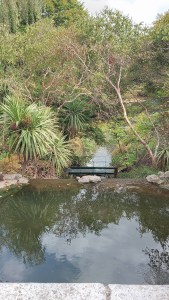
This is a Psalm about what it means to be blessed, and about the vivid contrast between the righteous and the wicked. That can feel almost too sharp – surely almost too simplistic – but as we look at the Psalm we will see that the complexities of real life are in view throughout. There is an underlying simplicity that we should not lose sight of – but it is a simplicity arrived out only through living in the midst of complexity and confusion.
Running through the Psalm is the contrast between the singular of v1-3 and the plural of v4-5 – the person described in v1-3 is singular, while the wicked are plural (this is obscured by some translations that avoid the “man” of the original by saying “those”). That the recipient of blessing is singular gives an emphasis on obedience that is prepared to stand out, that is ready to be a bit different. The person who receives blessing from Yahweh needs to be ready to stand out from the crowd.
This person is described here in negative terms, and then in positive terms. Firstly the negative. That person does not walk with the wicked, stand with sinners or sit with scoffers. This jarrs with us at one level – who are we to judge another – and yet we live in a culture that makes judgements about who is to be listened to, and who is to be silenced, all the time.
But the judgement measure here is the law of the LORD – the Torah of Yahweh – Yahweh’s teaching for his people. The wicked person is the person who stands against these instructions, these standards and lives in opposition to the story that Yahweh’s Torah (our first five books of the Bible) tells. The one who is blessed is the one who does not follow the ways of this opposition.
It isn’t telling us never to associate with those who don’t belong to God’s people – but it is telling us that we should be clear about who we spend time with, and in particular, who we are influenced by. Walking with, standing by the way and sitting down with are all acts that involved spending time with another, and imply some sort of action that chooses to spend that time.
The question it raises for us is – who do I choose to put myself under the influence of? Which websites do I browse most frequently? Who do I follow on social media? Which newspapers/sites do I look at most often? Who or what do I look to for advice on career, finance, parenting, etc…? When I am feeling low and want someone to encourage me, who do I turn to? If those things, or people, are not supportive of a walk with Yahweh, and with his ways, then we need to ask ourselves questions about what we are really looking for.
It’s worth saying too that those negative influences and destructive ways of living can be found among God’s people inside the church just as easily as outside – it is all too easy for Christian communities to become places operating in ways that subtly, or not so subtly undermine God’s instructions and story, and so become ‘the wicked’ of the Psalm – just think of the cases of bullying found within church circles in recent years, sometimes bullying that was allowed to carry on for years without opposition.
The remedy is found in the positive of v2 – the truly blessed person is the one who meditates on God’s Torah day and night because they delight in it. I’ve used Torah here instead of law because for us law sounds like a list of instructions. Torah is the word Jews use for the first 5 books of our Bibles – Genesis-Deuteronomy – and less than half of this is instructions.
Most of it is in fact narrative – story – story from before history of creation and fall, story from the dawn of history – God’s calling of one man to be the father of many, and story from the midst of history – God’s rescue of a people out of slavery into Egypt to be a priestly kingdom displaying his wisdom to the nations.
The instructions are part of this story – given to guide the rescued people into a life that lives out the love this God has lavished on them. Law is about how to live as one who is truly loved. Torah is law yes, but law in the context of a love story of a God who is determined to redeem his broken world. It is in this Torah that the truly blessed person delights, and on this Torah that he mediates – literally ‘mutters’ day and night. This Torah is never far from their lips.
For those of us reading as NT believers we have the whole canon of Scripture to read, delight in, and meditate on day and night. We read more of God’s story – how the nation he rescued developed, and of how God sent his Son to complete his rescue mission, and more of God’s instructions – how those who know his Son are to live out lives of love as lights to the nations around. We read to know the God who writes the story, and the God, who because he loves us so much, gives us instructions to guide us on how to live authentically in the midst of this story.
And to live with our lives rooted in this story is to live like a tree, rooted by water that keeps it alive and refreshed. That is what it means to be blessed. When we read “whatever that person does prospers” we aren’t to think that means we will be healthy and rich. No – instead it means that if we are truly rooted in God’s story and God’s instructions we will live out a life that is blessed, and in which the things we do that are authentically in line with God’s story and instructions will have the result that God wants them to have.
That doesn’t always look like success. The results God wants aren’t always visible to us. Sometimes it seems like a long and fruitless journey. Whether it is a dead end job, a family illness, a difficult relative, a struggle with our own health, dashed hopes or any number of long struggles which don’t seem to have a solution, following God doesn’t always look like it is producing success.
Which is why we need v4-5 – the life of the wicked, who don’t try to live in line with God’s story and instructions, doesn’t always look like chaff blown away by the wind. The wicked can look successful. We need to know that the outcome of moving away from God’s story and God’s instructions is death.
We need to know that Yahweh watches over – literally that Yahweh “knows” – the way of the righteous – and righteous here isn’t the person who gets everything right, but is rather the way of the person who is loyal to God, who is seeking to live their life in line with the love displayed in God’s story and God’s instructions. This person is utterly known by Yahweh.
Recently I was part of a conversation, and as that conversation went on it became clear that, because of their own circumstances that person got a particular key aspect of my life that I always struggle to explain to others. As I left that conversation I cried with relief. I had met someone else who got it. They knew. I didn’t have to explain. And in a similar way God knows our lives. God sees what is really going on. In the midst of all the struggle, and all the confusion that life can bring, that 2023 will no doubt bring in abundance, we can know that God knows. He sees us, and he has us. He knows.
This Psalm is an invitation at the start of a new year to renew our desire to delight in God’s story and God’s instructions that together show God’s lavish love to us. It is an invitation to pick a section of God’s word (the Psalms? Amos?) to read, to listen to, to speak to ourselves and to others, and to live in the light of. And as we do that we will begin to see what it looks like to be truly blessed.
Of course I never defined what blessed means. It is hard to fully capture the reality of this rich word. Some translations have ‘happy’ – but that is too light a word. Blessing can come in the valley. Blessing can come in tears. Blessing is about living with God’s approval. It is about knowing that God knows and feeling the comfort that brings. Understanding what it means to be blessed comes as we live out a Psalm 1 shaped life.
 Joshua's Tree Rooted